
Beyond the Façade: A Rereading of the Failed Detail of the Grenfell Tower
Article Sidebar
Main Article Content
Abstract
On 14 June 2017, a fire broke out on the fourth floor of the Grenfell Tower, a 24-storey public housing block in central London. It spread throughout the building and burned for 60 hours, killing 72, injuring more than 70, and inflicting irreparable damage. The Grenfell tragedy lies at the intersection of a social and relational problem of governing public housing and a tragic performance of deceitful material layers. In this article, the binary way of thinking of performance and matter solely loaded in science is questioned in order to define a space for understanding immaterial concerns as design tools and care as a political responsibility. The author questions the as yet undervalued immaterial moments of failure of the architectural detail in order to seek an alternative way of reading and drawing it. The two-dimensional straight lines of the conventional drawing of a detail section are investigated in order to question the ethics of practice in the context of a wider crisis of the built environment. What would a rereading of these failed details look like? How can we investigate the wall build-up, going beyond the limited understanding of performance to instead discuss the secluded interior, questions of care and domesticity, and injustices related to the politics of the façade?
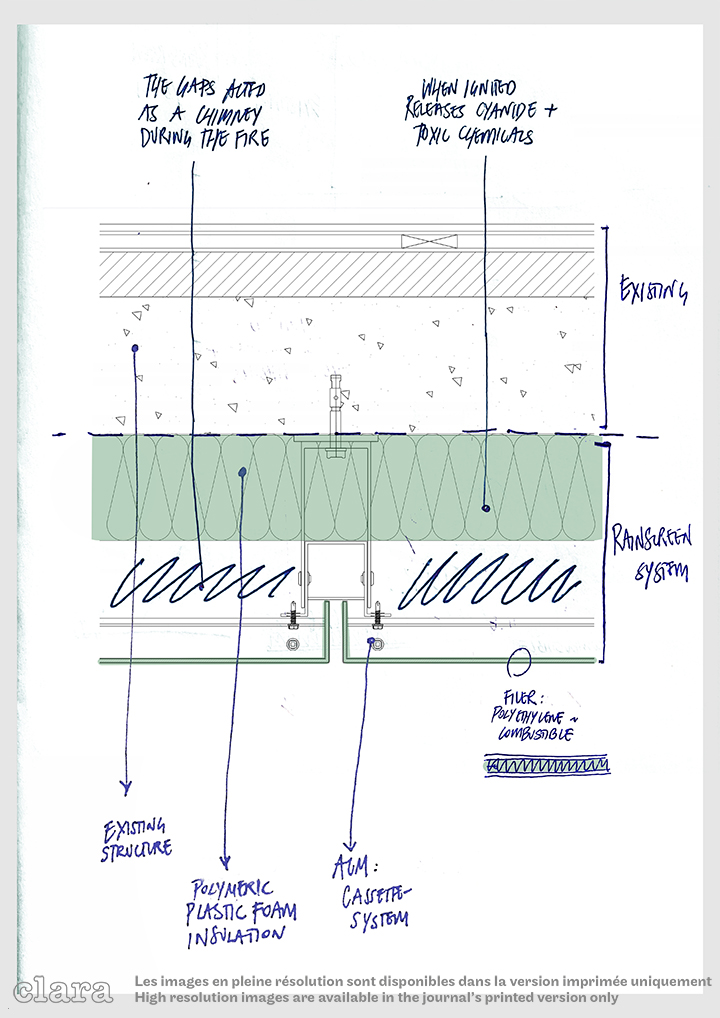
Image: The refurbishment of Grenfell: detail of wall section, annotated document by Giulia Rosa. © Dr Barbara Lane, expert witness presentation, Grenfell Tower Inquiry, June 2018.
Article Details

This work is licensed under a Creative Commons Attribution-NonCommercial-NoDerivatives 4.0 International License.